Today in class we started out with a homework check which reviewed HW 4.3 which was about the product and quotient rule (and some chain rule, too). After we finished the check, we went over problem 10 on the homework so that we could simplify it together. By finding the GCF and factoring, we were able to simplify the answer by a lot. Next, we took notes on 4.5 which refreshed us on domain and range, and a little bit of trigonometry. We also took notes on the derivatives of the six Inverse Trig Functions. After notes, Ms. Sommariva gave us a practice work sheet to do as well as our homework which is HW 4.5 and the 2003 FRQ. If you didn't finish the practice work sheet, that is homework as well.
-Dani
Monday, December 16, 2013

12/4/2013
In class, we took two concept tests - 9 and 10 - which were on . Then we answered questions about the chain rule worksheet and went to work on the take home review, in preparation for Chapter Test Three.
Wednesday, December 4, 2013
Class Minutes 12/2/13
Today in class, we used the power rule to derive a position equation into a velocity equation in order to find the time at which velocity equaled zero.


Next we did the Continuity and Differentiability worksheet.
A fxn is continuous at a point if:
f(c) exists
lim(x-->c) f(x) exists
f(c) = lim(x-->c) f(x)
A function is differentiable at a point if it is not a cusp and if f '(c) exists.
We learned how to make a piecewise fxn differentiable at a value when solving for k.
In order to do this you derive both fxn's of the piecewise fxn and set them equal to each other. Then you solve for k and plug it back into the original piecewise fxn.
Finally, at the end of class we learned the derivatives of the six trig fxn's.

Tuesday, November 5, 2013
Class 11/5/13
Today in class we did an entrance card that explained how to find the derivative of a function without using a forwards, backwards, or symetric difference quotient and writing it all out. In order to find the derivative of the function you simply take the value of the exponent and multiple it by the value of the coefficient in the function in order to get the coefficient of x for the derivative, and you subtract 1 from the exponent that was on the x. For example: g(x)=1x^4......g'(x)=4x^3. Then we took notes on the derivative of a power function. After that we took a concept test on the derivative of at a point. Then we did HW check 3.3 on sketching derivatives. Finally we did exploration 3-4a: Algebraic Derivative of a Power Function. That's all folks!
Saturday, November 2, 2013
Friday, November 1, 2013
Today in class we began class with the POD which was about explaining the difference between the derivative at a point and the derivative of a function. We then got our Chapter 2 tests back. After that we learned how to use the nDeriv function on the TI-83 and TI-84 calculator to graph the derivative and how to do the limit on N-spires. We then began working on the N-spires derivative exploration, which is how class finished.
For homework: Exploration 3.3b and Sketching Derivatives A-D (do the two you were given)
For homework: Exploration 3.3b and Sketching Derivatives A-D (do the two you were given)
Tuesday, October 29, 2013
In class on 10/28, we started off by Ms. Sommariva showing us some some tips of how to use the N-spire calculator. There are certain functions we didn't know about that would be helpful for us to check our work. For example, we learned that we can type in a function and it will give the factors for us. Also, we completed a problem in the notes packet where we were trying to foil a expression to the 4th power. In this case, we could use Pascal's triangle. The N-spires allowed us check our work by typing expression in.
Ms. Sommariva showed us a quick powerpoint about derivatives and tangent lines with graph examples.
We received a new notes packet and went over the chapter 3 test requirements, definition of derivative at a point, formulas for difference quotients and an example.
We ended class by completing a short exploration. We practiced the definition of derivatives at a point concept we learned in the notes packet.
Our homework assigned (due on 10/30) was to complete HWK 3.2 pg 76 Q1-Q10 #3, 5, 9, 15, watch this video http://www.youtube.com/watch?v=TINfzxSnnIE, and use the backwards or symmetric difference quotient to find the derivative of x^4.
-Kiley :)
Ms. Sommariva showed us a quick powerpoint about derivatives and tangent lines with graph examples.
We received a new notes packet and went over the chapter 3 test requirements, definition of derivative at a point, formulas for difference quotients and an example.
We ended class by completing a short exploration. We practiced the definition of derivatives at a point concept we learned in the notes packet.
Our homework assigned (due on 10/30) was to complete HWK 3.2 pg 76 Q1-Q10 #3, 5, 9, 15, watch this video http://www.youtube.com/watch?v=TINfzxSnnIE, and use the backwards or symmetric difference quotient to find the derivative of x^4.
-Kiley :)
Thursday, October 17, 2013
IVT and Continuity examples
We will review the IVT and proofs of continuity in class on Tuesday when we are all back together. However, after looking at your work on the review stations, I wanted to share some of the work of your classmates.
Here is a good example of the work expected when using the IVT:
 Here is a good example of the work expected when proving continuity:


In class 10/15 we worked at different stations that had to do with limits. There were four stations that each had to do with a specific learning style. The "Understanding" station had the group go online and post everything that we knew about the key words in our unit like: limit, derivative, etc. The "Self Expressive" station had each member of the group write a letter to the author of our textbook saying whether we thought limits and continuity should be in the same chapter or not. The "Interpersonal" station had the group work together on solving the magic box. The "Mastery" station had us solving limit problems. All of these stations helped to reinforce what we have learned about limits and deepen our thinking about their connections with other things we have learned such as derivatives and continuity. After we finished the stations we were able to begin working on our homework, which was the back of the analyzing limits sheet.
Tuesday, October 15, 2013

Another Limit Example (with lots of algebra!)
Here is another limit example from the Magic Squares you did in class today. In order to solve this limit algebraically, you needed to use the difference of cubes and difference of squares for factoring.


Monday, October 14, 2013

 .
. .
.
 .
.


Saturday, October 12, 2013
10/11/13 Class reflection
Today in class, we started out with the daily problem which touched upon our understanding of definite integrals. After that, we went over the FRQ that had been assigned to us the class before (10/9/13). The first question of the FRQ just required us to use derivatives to figure out the rate at which the number of people waiting in line changed at 5:30pm. In part two of the FRQ, we had to use the trap rule to figure out a definite integral of the average number of people waiting in line during the first 4 hours that the tickets were on sale. As a reminder, the trap rule is as follows: 1/2(b1 + b2). In the third part of the FRQ we were asked to figure out the fewest number of times at which L'(y) must equal 0, and Ms. Sommariva had to walk us through this one because the IVT is a relatively new concept to us. After we went over the FRQ together, we moved onto the homework check. The homework check tested us on our understanding of limits and the IVT. After we finished the homework check, we took two concept tests, one on concept #3 (continuity) and the other on concept #4 (evaluating limits). This pretty much sums up what we did in class yesterday.
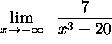
Daniel's Limit Example

Friday, October 11, 2013
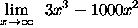
Kiley's Limit Example

Daum Equation Editor Assignment
Your assignment is to make a comment to this post (not a new post) that uses Daum Equation Editor to show a limit example. Use limit notation to write the example and then make sure to evaluate it. You can also use each others' examples to study limits for your Chapter 2 test. This post is due by Tuesday October 15th.
Thursday, October 10, 2013
Wednesday October 9th
Last class we started with a POD as usual. We then went over check 2.45 because many people had questions on the last problem. I don't have this to go over but there was a similar problem on the limits worksheet, so I will explain that. Exercise 5 on that worksheet said:
lim (1+h)^4 -1 0 1
h--> 0 h 1 1 1
2 1 2 1
3 1 3 3 1
4 1 4 6 4 1
1(1^4)(h^0) + 4(1^3)(h^1) + 6(1^2)(h^2) + 4(1^1)(h^3) + 1(1^1)(h^4) substitute into function
(1 + 4h + 6h^2 + 4h^3 + h^4) -1 ones cancel, factor h out of polynomial
h
h(4 + 6h + 4h^2 + h^3) h cancels, substitute to find answer
h
4 + 0 + 0 + 0 = 4 final answer
Basically you need to expand the polynomial in the numerator. when expanding anything more than the power of 2 or 3 it is easier and faster to use pascal's triangle. This is review from pre-calc but you use the triangle by looking at the row of the triangle that corresponds with the degree you are raising the polynomial to. Then for each number in the series you multiply the first value in the original polynomial to the highest degree (and in descending order as you move onto the next term) and the second value to the 0th degree which is always one (and in increasing order as you move to the next term). It may be easier to understand looking at the example above.
We also went over part two of the FRQ 2003 #6 which was a helpful to show how the AP wants the answer found when there is no calculator. Then we did the two part exploration. Finally we received our homework...
HOMEWORK DUE FRIDAY: the new FRQ 2008 #2 we got last class as well as check 2.5. No bookwork
Josh Gervais
Last class we started with a POD as usual. We then went over check 2.45 because many people had questions on the last problem. I don't have this to go over but there was a similar problem on the limits worksheet, so I will explain that. Exercise 5 on that worksheet said:
lim (1+h)^4 -1 0 1
h--> 0 h 1 1 1
2 1 2 1
3 1 3 3 1
4 1 4 6 4 1
1(1^4)(h^0) + 4(1^3)(h^1) + 6(1^2)(h^2) + 4(1^1)(h^3) + 1(1^1)(h^4) substitute into function
(1 + 4h + 6h^2 + 4h^3 + h^4) -1 ones cancel, factor h out of polynomial
h
h(4 + 6h + 4h^2 + h^3) h cancels, substitute to find answer
h
4 + 0 + 0 + 0 = 4 final answer
Basically you need to expand the polynomial in the numerator. when expanding anything more than the power of 2 or 3 it is easier and faster to use pascal's triangle. This is review from pre-calc but you use the triangle by looking at the row of the triangle that corresponds with the degree you are raising the polynomial to. Then for each number in the series you multiply the first value in the original polynomial to the highest degree (and in descending order as you move onto the next term) and the second value to the 0th degree which is always one (and in increasing order as you move to the next term). It may be easier to understand looking at the example above.
We also went over part two of the FRQ 2003 #6 which was a helpful to show how the AP wants the answer found when there is no calculator. Then we did the two part exploration. Finally we received our homework...
HOMEWORK DUE FRIDAY: the new FRQ 2008 #2 we got last class as well as check 2.5. No bookwork
Josh Gervais
Saturday, October 5, 2013
Thursday 10/3/13
We started off the class with a daily problem. Once finished, we moved into notes 2.4 We went over these notes that we had taken the night before to clarify any problems we had and to expand on what we wrote down slightly. We also took notes 2.45 on the continuity of piecewise functions, and boolean variables. In order to type in a piecewise function on a TI-nspire, go to your graphing window. When you are prompted to insert your function, press the button on the right side below the delete button and left of the button that has a book on it. In the menu on the screen, choose the one with the curly bracket, and four boxes. Then, type your first equation in the upper left box, and its restrictions to the right of it. Do the same with your second equation, except in the lower left and right boxes. To do this on a TI-83/84, go into y=. In Y1, type in your first equation in parentheses. After the equation, put a division symbol and the equations restrictions in parentheses after the division. You can get to the greater than, less than, and more symbols by pressing the math button. Do the same thing for the second equation, except typing it in Y2. We then answered any questions we had on the book work and the evaluating limits worksheet. We did check 2.4 regarding the concepts we have been learning and did an exploration regarding continuous and discontinuous piecewise functions. We finally finished up class with grabbing the FRQ and starting it if we had time.
Tuesday, October 1, 2013
Tuesday 10/1/13
Today in AP Calc. we started with the problem of the day about the open box, and writing the equation to find the volume of it. Following this we completed the Homework Check 2.3 which involved finding delta values along with finding the limits graphically. We then took some notes on finding the limit algebraically using either Substitution, where you can just take the x-value and plug it into the equation, Factoring, where you use synthetic division to factor the top of the function so that there is a similar term in the numerator and denominator that will cancel out. You then do substitution to figure out the limit. The third way is using Conjugate Method, which is only used if you cannot factor, which in most cases is when there is a square root. With this you take the conjugate of the numerator and using the magic box, get it so that there is a factor in both the numerator and denominator that will cancel out. You can then use substitution to find the limit. We were then given the Limit Worksheet to begin our homework.
TONIGHT'S HOMEWORK: Finish Graphical Approach to Limits packet, #1-4 on the Evaluation Limits worksheet, complete the page 1 notes for 2.4, watch the two videos posted on the website, and finish HW 2.3 - p. 43 Q1-Q10 #10, 11, and 17
TONIGHT'S HOMEWORK: Finish Graphical Approach to Limits packet, #1-4 on the Evaluation Limits worksheet, complete the page 1 notes for 2.4, watch the two videos posted on the website, and finish HW 2.3 - p. 43 Q1-Q10 #10, 11, and 17
Monday, September 30, 2013
Thursday, 9/19/13
Today in class, we started off with a daily problem like usual. This daily problem was was about integrals, more specifically Riemann Sum. You needed to use right sided rectangles to solve this problem. After going over that, we worked on the "Trapezoid and Midpoint Approximations" packet, using the Ti-nSpires. In the packet, we looked at a couple different types of graphs, using right, left, and midpoint triangles to estimate under the curve of the function. When we finished the packet we handed it in and did concept tests 2 & 18 - estimating area with a curve and Riemann Sums.
Monday, September 23, 2013
Mobile Blogging
You can now make your posts to the Calculus blog using a smartphone. If you can send email from your phone, simply type the post you want to make into the body of an email. Send the email to Laura.Sommariva.Calculus@blogger.com and your post will automatically go to the blog!
Tuesday, September 17, 2013
Friday 09/13/13
We started class with a POD, which involved exponent properties. The class was interrupted by the clear the halls drill, but afterwards we took the concept quiz. We then moved on to a homework check, which concerned mostly the same things we've been working on: finding the area of trapezoids, estimating instantaneous rate of change, counting boxes ect. Then we took notes on the Trapezoidal Rule, which is an equation that lets you quickly add up all the components of multiple trapezoids to estimate the area under a curve. We finished class up by getting a new calculator program that does the traprule equation for you. The Homework for next class (1.4) requires this program, so make sure to talk to Ms. Sommariva if you don't have it.
TO USE THE PROGRAM: Hit the PRGM button on your calculator. Find the TRAPRULE option and hit enter, and then enter again. A= the lower bound, B= the upper bound and n= the number of trapezoids.
TO USE THE PROGRAM: Hit the PRGM button on your calculator. Find the TRAPRULE option and hit enter, and then enter again. A= the lower bound, B= the upper bound and n= the number of trapezoids.
Sunday, September 15, 2013
Trap Rule Program
If you are trying to use the trap rule program at home with the TI-83 or TI-84 calculator, make sure that you have the equation for which you are estimating the integral typed into the Y= screen. The program will automatically use the function in Y1. If anyone is having any problems with it, please create a comment here to my post.
Thursday, September 12, 2013
Wednesday 09-11-13
First, we completed the POD which was finding the center of a circle. We then quickly went over the homework(MAKE SURE TO HAVE CALCULATOR IN RADIANS FOR CALCULUS) and moved on to notes 1.3 on the first type of integral, definite integral-area between the curve and the x-axis or value of the area over a specific interval. We learned how to graph definite integrals on both the NSpire and our TI-83/84's. Then we worked on Exploration 1-3a and counted boxes to estimate the integrals.
Homework: pg. 16 Q1-10, #2a, 3a, 7, 12-14.........also to be ready for a concept test on Tuesday on instantaneous rate of change.
Homework: pg. 16 Q1-10, #2a, 3a, 7, 12-14.........also to be ready for a concept test on Tuesday on instantaneous rate of change.
Tuesday, September 10, 2013
Monday 9/9/10
We began with an entrance card, where we put down what the word limit brings to mind. After, we went over a homework problem that was a slightly troublesome (17), figuring out that the book wanted us to use the terms above and below the indicated term to find its rate of change. We watched a video on limits (intended heights of functions) that gave a brief overview of what limits were.
Then, we finished up Notes 1.2, writing what made a rate of change positive (increasing) and negative (decreasing), and then reviewed asymptotes. We began a worksheet on a Limiting Sequence, using the NSpire calculators, finding the approximate limit of the system, to finish for homework.
Then, we finished up Notes 1.2, writing what made a rate of change positive (increasing) and negative (decreasing), and then reviewed asymptotes. We began a worksheet on a Limiting Sequence, using the NSpire calculators, finding the approximate limit of the system, to finish for homework.
Sunday, September 8, 2013
9-5-2013
During class today we wrapped up the 1.1 notes with the Inspire Calculators, learning again how to put the function in and find the derivative. After that we moved back to the calculators most of us have, the TI-83 and 84's. We learned how to plug in the function and find the derivative on those.
Then we had some fun time and played a couple of games of pictionary, ending the class with this.
For homework we had to take 1.2 notes online(just the definitions) and the problems for the 1.2 homework on the front of the notes packet!
Saturday, September 7, 2013
Make sure you are thorough with your explanation of what we did in class so that those who weren't there can understand. Also, don't be shy to share your knowledge if someone asks a question. The whole purpose of the blog is to help one another out and even if you aren't 100% certain, your ideas are still valuable.
Wednesday, September 4, 2013
Tuesday 9/2
- Went over the Concept Quiz system and a brief overview of the year's concepts.
- Notes 1.1 - Instantaneous Change
- Limit: The anticipated height of a function
- Average rate: amount of change over time, such as mph
- Instantaneous rate of change: the slope of a function at a particular moment in time, the amount a function changes in one instant
- Derivative: Instantaneous rate of change (slope) at a specific moment
- Used the fancy new NSpire calculators
- HW: exploration 1-1a; pg5 #1,2
Thursday, August 29, 2013
Class Notes 08.29.2013
Calculus Notes from August 29
- The first thing that we did was the POD. This problem was concerning Sec 5π / 4. To solve this you could convert to degrees using the conversion 180 / π. This gave you a degree measure of 225. This meant that it was in the third quadrant with a reference angle of 45 degrees. This means that that specific triangle of the bow tie is a 45-45-90 triangle. This also tells you that the two sides across from the 45 degrees are 1 unit and the hypotenuse is root 2. The corresponding trigonometry term for Secant is Cosine. Cosine of the reference angle is -1 / root 2 and so the flip of that (the Secant) would be negative root 2. (I apologize for "root" but I don't know how to insert that symbol)
- We then did a questionnaire with an array of personal and math related questions. This was used to see how students can have different interpretations of the same question.
- Finally, we learned how do go from a distance graph, to a velocity graph, and then to an acceleration graph.
- With a distance versus time graph, you simply plot the points given of distance versus time.
- With the velocity versus time graph, you take the distance traveled per second and plot those points on the graph. So if on the distance graph at 1 second you were at 3 feet and at 2 seconds you were at 7 feet, then the velocity for 2 seconds would be 4 because you traveled 4 feet in that second.
- With the acceleration versus time graph, you draw a tangent line on the velocity graph at each point. Then you take the slope of that line in order to get the acceleration at that particular moment. So if you were to draw a tangent line at 1 second on the velocity graph and that line had a slope of 2, then you would plot an acceleration of 2 and time 1 second.
- With a distance versus time graph, you simply plot the points given of distance versus time.
- With the velocity versus time graph, you take the distance traveled per second and plot those points on the graph. So if on the distance graph at 1 second you were at 3 feet and at 2 seconds you were at 7 feet, then the velocity for 2 seconds would be 4 because you traveled 4 feet in that second.
- With the acceleration versus time graph, you draw a tangent line on the velocity graph at each point. Then you take the slope of that line in order to get the acceleration at that particular moment. So if you were to draw a tangent line at 1 second on the velocity graph and that line had a slope of 2, then you would plot an acceleration of 2 and time 1 second.
Wednesday, August 28, 2013
Math Lingo on our Blog
Students had a difficult time last year writing the "math lingo" parts of their posts, but now it looks like the problem has been solved!
If you need to use appropriate math notation in your blog post, just go to Daum Equation Editor. This equation editor works the same way the one in Microsoft Word works. Once you have typed in your equation you can save it as an image.
When you are typing your blog post, insert your image by clicking the picture icon and choosing the appropriate file. Align it as you'd like and voila!

If you need to use appropriate math notation in your blog post, just go to Daum Equation Editor. This equation editor works the same way the one in Microsoft Word works. Once you have typed in your equation you can save it as an image.
When you are typing your blog post, insert your image by clicking the picture icon and choosing the appropriate file. Align it as you'd like and voila!
Monday, August 26, 2013
Friday, August 23, 2013
Welcome to Blogging in Calculus
Welcome to the AP Calc blog! This is going to be your resource for communicating with one another about what is going on in AP Calculus. Every day a different student will be assigned to write a post about what we did in class that day. We will then be able to refer back to this post to remind ourselves what we're learning about. What was the major concept being covered that day? What new skills did we learn? What old skills are we building upon? What questions do you still have? What issues did the homework bring up?
In addition to your assigned post, you are also welcome to add other posts and comments with your thoughts, insights, and concerns about particular lessons or concepts. There will be other times when I post a question for you to answer about a lesson, topic, or problem.
Because we will be blogging in a public forum, it is important that we have good internet and blogging etiquette. Your task before school starts is to comment on this post with at least one rule you think we should all follow as we embark on our blogging quest together. Try to come up with different rules than those who have commented before you. For now, I have turned on comment moderation, which means I will get an email for every comment you place on the blog. As soon as I know we have all agreed to a set of blogging standards I will turn off comment moderation.
I hope this will be a rich resource for you to learn, create, reflect, ponder, and help one another on your quest to learn calculus.
In addition to your assigned post, you are also welcome to add other posts and comments with your thoughts, insights, and concerns about particular lessons or concepts. There will be other times when I post a question for you to answer about a lesson, topic, or problem.
Because we will be blogging in a public forum, it is important that we have good internet and blogging etiquette. Your task before school starts is to comment on this post with at least one rule you think we should all follow as we embark on our blogging quest together. Try to come up with different rules than those who have commented before you. For now, I have turned on comment moderation, which means I will get an email for every comment you place on the blog. As soon as I know we have all agreed to a set of blogging standards I will turn off comment moderation.
I hope this will be a rich resource for you to learn, create, reflect, ponder, and help one another on your quest to learn calculus.
Subscribe to:
Posts (Atom)